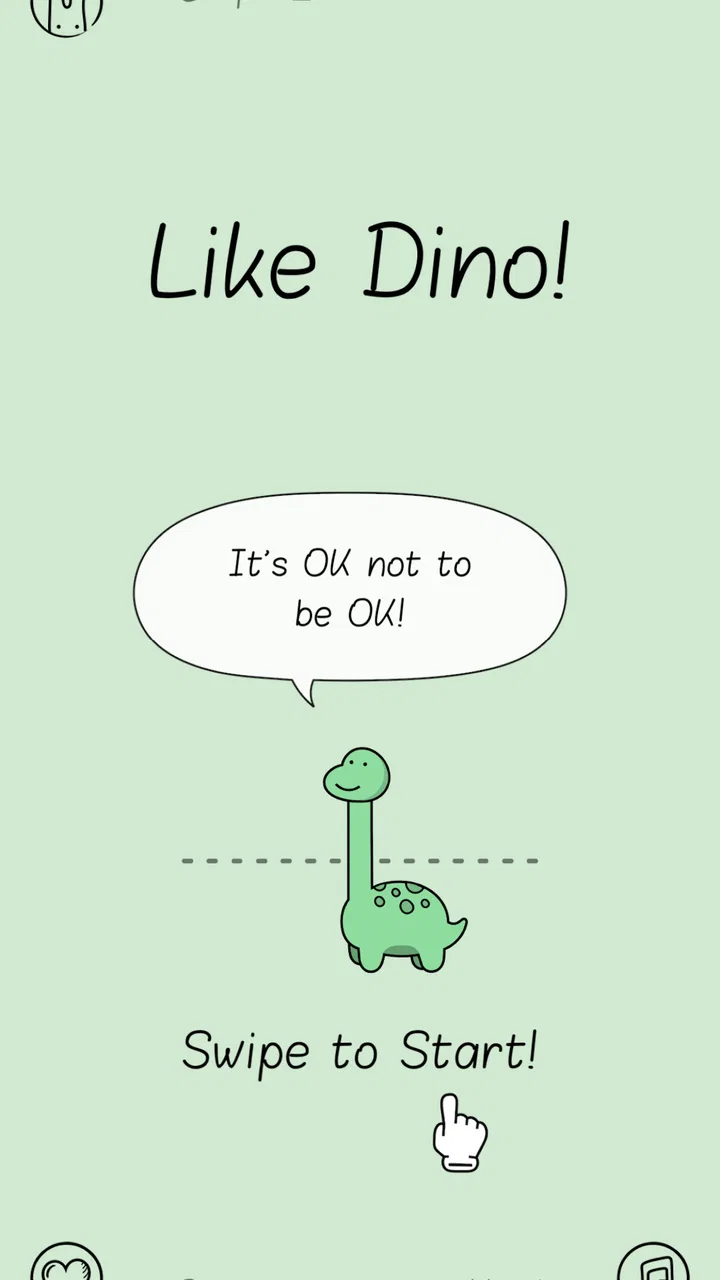
Like Dino!
- 4.9
- Rating
- 10.00M
- Installs
- Free
- Price

 Analysis by App-foxy
I spent time with Like Dino!, a free music game from super_toki, and its appeal is easy to understand: it takes a very simple action and turns it into a small timing challenge. The store summary calls it a musical game, while the short description points to its dinosaur theme. That combination gives it a friendly first impression, but the real question is whether the simplicity stays enjoyable after the first few sessions.
My answer is yes, with an important qualification. This is best approached as a quick rhythm distraction rather than a complete music-training tool or a deep arcade campaign. I found it most useful when I wanted something light that could be played in short bursts, without the preparation demanded by a larger rhythm title. It is free, rated for Everyone, and available for Android devices running version 6.0 or later, so it is also an easy game to consider for a broad range of players.
How the musical dinosaur concept works in everyday play
The central pleasure comes from matching your actions to the musical flow. Like Dino! does not need a complicated control scheme to create tension. Instead, it asks you to pay attention, anticipate the next moment, and react cleanly. That makes the game immediately approachable for someone who normally avoids rhythm games, while still leaving room for mistakes when the pace begins to demand more concentration.
You May Also Like

 Blood Strike: 2.5 Anniversary
Blood Strike’s Loadouts Turn Every Drop Into a Tactical Gamble
A close look at Blood Strike’s custom loadouts: how fast access to signature weapons reshapes its battle royale rhythm, rewards preparation, and narrows the gap between fights.

 Pandora - Music & Podcasts
Pandora’s Music Is Easy to Start, but Harder to Recover
Pandora’s strength is its low-effort path from a seed to a station. Its weak spot is how much confidence it asks you to place in connection, setup, and quiet recovery.

 8 Ball Pool
 Is Built on Rivalries, Rematches, and Routine
A close look at the rivalries, rematches, shared routines, and unanswered safety questions that turn a quick pool match into a persistent mobile community.

 Samsung Music
’s Quiet Strength Is Playing What You Already Own
Its reach comes less from spectacle than from dependable access to a personal library. That simplicity is both the app’s strongest retention engine and its ceiling.

 AccuWeather: Weather Radar
AccuWeather Review: A Quick, Clear Forecast for Everyday Decisions
For everyday plans, the best forecast is the one you can understand quickly. AccuWeather makes rain timing, radar, and local conditions easy to act on, with a few trade-offs.

 Hill Climb Racing
Why Hill Climb Racing Still Turns Crashes Into One More Run
A tiny car, a bumpy hill and one more upgrade: Hill Climb Racing keeps resurfacing because its simple chaos makes every near-miss feel personal.
More From Our News Desk
View All News


I would describe the first few minutes as learning the game’s language. At the beginning, the visual idea and the music do much of the work. You are not studying a long tutorial or memorizing a large set of commands. You are watching, listening, and trying to keep your timing consistent. That low barrier is one of the strongest reasons I would recommend it to a casual player.
The dinosaur presentation also matters more than it might seem. A generic timing exercise can feel cold, especially when a player is still deciding whether to continue. The character-focused style gives the experience a softer personality. It feels playful rather than technical, which makes a missed input easier to accept. I still wanted to improve, but I did not feel as if I were being tested by a serious training program.
That simplicity has a trade-off. Players who expect a large song library, extensive customization, or a story-driven progression system may find the experience too narrow. Like Dino! is built around its core musical interaction, not around a long list of unrelated activities. If your ideal rhythm game is one with many modes and a large amount of content to unlock, a more traditional music game will probably offer more variety.
For a quick session during a commute, a short break, or a few quiet minutes before bed, the compact design works well. I could start playing without first deciding which complicated mode to enter. That matters on mobile, where the best game is often the one that respects the small amount of attention you have available.
The best way to approach the timing
My first useful adjustment was to stop staring only at the character. The visual theme is charming, but the rhythm is easier to follow when I let my attention move between the action area and the sound. Watching for the next visual cue while listening for the beat creates a more reliable response than reacting to the animation alone.
Another practical tip is to treat early attempts as calibration rather than performance. If you immediately chase a perfect run, a single error can make the session feel frustrating. I had better results when I used the opening moments to settle into the tempo, then concentrated on consistency. That approach is especially helpful for younger players, who may enjoy the theme but need time to understand that rhythm games reward patience more than frantic tapping.
Playing with sound is important. The game belongs to the music category, and the audio is not just decoration. Without it, the experience becomes more dependent on visual reaction and loses part of what makes the format satisfying. If you are in a place where sound is not practical, the game can still be considered, but it is unlikely to show its best side.
I also recommend shorter sessions when your timing starts to deteriorate. Rhythm games can create the illusion that one more attempt will fix everything, even when fatigue is making your reactions worse. With this title, taking a break is not wasted progress. Returning with a clearer sense of timing can be more productive than repeating the same mistake for several minutes.
Progress, pressure, and the appeal of another attempt
The main pressure comes from trying to improve your control and maintain a better run. That is a familiar arcade loop: play, miss a moment, understand what went wrong, and try again. It is effective because the rules are easy to remember. I never needed to spend time rebuilding my understanding of the game after closing it and returning later.
At the same time, this kind of progress is personal rather than dramatic. If you need a strong sense of character development, a detailed campaign, or a visible narrative payoff, the game may feel modest. Its satisfaction comes from cleaner timing and greater confidence, not from a complex story that continually changes the stakes.
That distinction is useful when deciding whether it belongs on your phone. I would choose Like Dino! for a player who enjoys chasing small improvements. I would not choose it for someone who wants a role-playing structure around the music or a large competitive ladder. The game’s pressure is immediate and mechanical: can you stay in the rhythm, and can you do a little better next time?
There is also a subtle difference between fair difficulty and exhausting repetition. A timing game can encourage retries because the player understands the mistake. It becomes less satisfying when failure feels unrelated to what the player could reasonably see or hear. In my experience, the fairest way to play is to focus on repeatable rhythm rather than rushing after a single impressive attempt. That mindset reduces the sense that every run has to be perfect.
For parents, the Everyone age rating makes the game easier to consider as a family-friendly option. I would still recommend that adults try it themselves before handing it to a child, not because the rating raises a concern, but because each child responds differently to repeated failure and fast reactions. The cheerful presentation may be inviting, while the timing demand can still require patience.
Spending, fairness, and what I would expect before installing
Like Dino! is free to download, which removes the most obvious barrier to trying it. That is valuable for a small casual game: you can discover whether its rhythm suits you without committing money first. The developer is super_toki, and the game has reached over ten million installs, with an average rating of 4.9 from around six hundred thousand ratings. Those figures suggest that the simple concept has connected with a very large audience.
Still, popularity should not replace personal judgment. A high rating cannot tell me whether the pace will suit your reflexes, whether you prefer more musical variety, or whether you dislike retry-focused games. I would use the free entry as a reason to test it, not as proof that it will become your favorite.
On spending specifically, I prefer to separate what is clear from what would be guesswork. The confirmed price is free, but I would not describe particular paid items, subscriptions, advertising behavior, or purchase advantages without reliable information about them. That matters when discussing fairness. It is better to say exactly what can be established than to promise a completely purchase-free experience or accuse the game of pressure without evidence.
From a player’s perspective, the important fairness question is whether success depends mainly on timing and attention. The game’s visible identity is built around musical play, so I would judge it first as a skill-based experience rather than a collection game. If you are comfortable with a free title whose value comes from repeating its central challenge, the model is easy to understand. If you want complete certainty about every possible spending prompt before playing, check the current store and in-game presentation on your own device before making a decision.
That is also where expectations should remain realistic. Free games sometimes rely on optional commercial elements, but the available facts do not justify me inventing details about how those elements work here. My trust verdict is therefore practical: the free download makes trying it low-risk, while the absence of a detailed purchase explanation in this review means you should pay attention during setup and play rather than assuming anything beyond the listed price.
How it compares with larger rhythm games
Compared with a full-featured rhythm game, Like Dino! feels deliberately focused. Bigger alternatives often provide more songs, more control options, stronger progression systems, or a wider range of difficulty settings. They can be better choices for players who want to build a long-term music library or practice a particular style of input.
Where this game has the advantage is immediacy. I do not need to learn a dense interface before enjoying the basic idea. The dinosaur theme makes it less intimidating than a serious music simulator, and the short-session structure suits people who want entertainment rather than a major hobby. In that sense, it competes less with large rhythm games than with the spare moments in which you might otherwise open a social feed.
It also compares favorably with ordinary casual games when you want something that rewards listening. Many quick mobile games depend mostly on visual matching or repeated swipes. Here, paying attention to the musical pulse gives you a more active role. That does not make it a substitute for learning an instrument, but it does make the interaction feel more engaging than a purely passive distraction.
I would skip it in favor of a more advanced alternative if you already know that you need deep customization, a substantial campaign, or a broad catalog of tracks. I would also skip it if you prefer games where progress continues even when your reactions are not improving. Like Dino! asks you to participate directly; it cannot provide the same satisfaction as an idle or story game when you are too tired to concentrate.
Device expectations and the questions I would ask before playing
The current version is 2.9, and the minimum operating system is Android 6.0. That gives the game a broad compatibility range for Android users, although compatibility on paper is not the same as identical performance on every phone. Older hardware may handle a simple game comfortably, but timing-based play is sensitive to interruptions, sound delays, and touch response.
For the best experience, I would close demanding apps, use a stable audio setup, and avoid playing while the phone is struggling with notifications or background activity. These are not glamorous tips, but they matter more in a rhythm game than they do in a turn-based title. A small delay or distracting interruption can make a missed beat feel like the game’s fault even when the real issue is the device environment.
If you are wondering whether an internet connection is required, I would check the current behavior directly on your phone rather than assume. The important point is that the core appeal is self-contained musical timing, so I would not install it expecting an online social platform or a multiplayer competition. Likewise, if you need accessibility controls for hearing, vision, or precise touch input, test the game carefully. Its reliance on rhythm and reaction may not suit every player, even though the age rating is Everyone.
Another question is whether children can play independently. The controls are approachable, and the theme is gentle, but independent play depends on the child’s comfort with timing and repetition. I would introduce it as a short challenge, not as an endless task that must be mastered. That keeps the experience playful and avoids turning a free mobile game into a source of unnecessary pressure.
For adults, the useful scenario is simple: you have five minutes, want something more active than scrolling, and do not want to commit to a long session. For a music enthusiast, it can serve as a lightweight timing diversion. For someone seeking structured musical education, it is the wrong tool. The distinction is important because the category label may suggest more depth than the compact design is intended to provide.
What I trust about the experience, and where I stay cautious
The strongest part of Like Dino! is its clarity. The game communicates its basic idea quickly, gives the music a meaningful role, and uses a friendly dinosaur identity to make repeated attempts feel approachable. I also like that the free price lets curious players test the concept without a purchase decision at the door.
Its limitations are equally clear. The focused design may become repetitive for players who need constant novelty. The challenge depends on attention and timing, so it is not ideal for passive play. A player who wants a large, evolving music platform will likely outgrow it, while a player who enjoys compact arcade loops may find that restraint refreshing.
The public response is unusually strong: the game holds a 4.9 average across roughly six hundred thousand ratings and has about forty-five thousand written reviews. It was released on November 8, 2020, and its continued presence suggests that the basic formula has remained relevant to many players. I treat that as encouraging context, not a guarantee that every session will feel fresh.
My recommendation is to install it if you want a free, family-friendly music game with a low learning curve and a clear reason to replay. Try it with sound on, give yourself a few attempts before judging the timing, and stop when concentration drops. I would recommend a larger rhythm title instead if your priority is song variety, deep progression, or competitive systems.
Overall, I see Like Dino! as a trustworthy casual pick within its narrow lane. It does not need to pretend to be a complete music platform. Its value is in turning a few spare minutes into a small test of listening and reaction, wrapped in a cheerful dinosaur theme. If you want a simple rhythm challenge rather than a huge game, this is an easy free download to try.
FAQs for Like Dino!
01What is the primary objective of Like Dino!?
The primary objective of Like Dino! is to guide an adorable dinosaur through a rhythm-based adventure. Players must tap in sync with the music to help the dinosaur collect notes, creating a delightful musical experience. The game's simplicity and charming visuals make it appealing to players of all ages.
02Is Like Dino! suitable for children?
Yes, Like Dino! is suitable for children and is designed to be family-friendly. Its simple controls, colorful graphics, and catchy tunes provide a fun and engaging experience for younger audiences while also offering a challenge for older players.
03Does Like Dino! require an internet connection to play?
Like Dino! can be played offline, making it perfect for on-the-go entertainment. However, an internet connection might be required for certain features such as downloading additional content or participating in online leaderboards. Always check the app’s requirements for specific details.
04Are there in-app purchases in Like Dino!?
Like Dino! offers in-app purchases that allow players to enhance their gaming experience. These purchases may include cosmetic items, additional music tracks, or other features. While the game is free to play, these optional purchases can enhance gameplay but are not necessary to enjoy the core experience.
05What platforms is Like Dino! available on?
Like Dino! is available on both Android and iOS platforms. This allows a wide range of users to download and enjoy the game on their smartphones or tablets, ensuring accessibility for players regardless of their device preference. Check the app store on your device for compatibility.
Pros
- Simple and addictive gameplay.
- Charming and unique art style.
- Relaxing music enhances experience.
- Easy to learn
- hard to master.
- Frequent updates with new content.
Cons
- Limited game modes available.
- No multiplayer option.
- Can be repetitive over time.
- In-app purchases for extras.
- Requires internet for some features.

Like Dino!
Gallery